Who was Saint Peter?
Cornerstone of the Church.

Chapter Text
Beyond the Keys to the Kingdom: 5 Surprising Truths About St. PeterIntroduction: The Man Behind the Icon
When we picture St. Peter, a monumental image often comes to mind: the steadfast "rock" upon which the Church was built, the unwavering apostle, the gatekeeper holding the keys to the Kingdom of Heaven. He is an icon of authority and foundational strength, a figure seemingly carved from stone.
But behind this towering religious symbol lies a far more complex, flawed, and ultimately relatable human being. The historical and scriptural records paint a picture not of a perfect saint, but of a man who was at times rash, fearful, and uncertain. This article explores five surprising truths from the historical record that reveal the man behind the myth and offer a more nuanced understanding of one of history's most influential figures.
1. He Was a Married Fisherman with Children
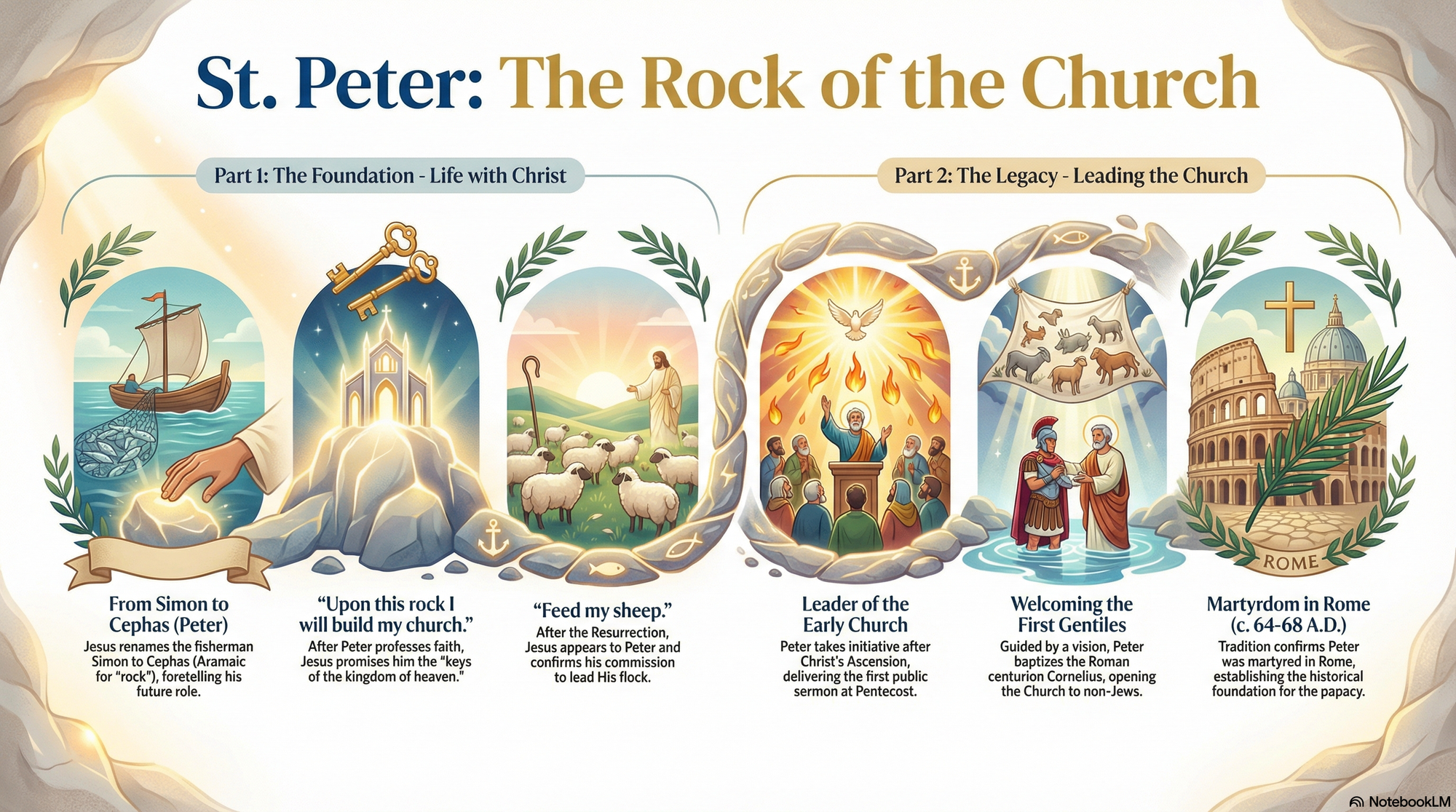
Long before he was a leader of the nascent Christian faith, St. Peter was a man with a family and a trade. His original name was Simon, and he was a fisherman from the town of Bethsaida who had settled in Capharnaum. The Gospels make it clear he was not a solitary ascetic but a man with deep worldly ties, even "possessing his own boat."
He was married and, according to early Christian writers like Clement of Alexandria, had children. The scriptural accounts even note that he lived with his mother-in-law, whose healing by Jesus is a well-known episode. This grounding in family life extended to his wife, about whom a poignant tradition survives.
According to Clement of Alexandria, the tradition relates that Peter's wife suffered martyrdom.
Knowing that Peter was a husband, father, and provider with a home and a business grounds him in a reality we can all understand. It transforms him from an abstract figure into a real person who answered the call to follow Jesus while still bearing the responsibilities of family life.
2. His Famous Nickname, 'The Rock,' Was Foretold at His First Meeting with Jesus
Many assume the name "Peter" was bestowed at the famous moment when Christ declared, "upon this rock I will build my church." While that was the moment its full meaning was revealed, the name change was actually foretold much earlier, at their very first encounter.
When Peter's brother, Andrew, brought him to meet Jesus for the first time, Jesus looked at the fisherman Simon and immediately spoke of his future identity.
"Thou art Simon the son of Jona: thou shalt be called Cephas, which is interpreted Peter".
This prophecy was a clear signal of Peter's destiny. As the historical source notes, this moment was "a proof that Christ had already special views with regard to Simon." The name itself is profoundly significant: "Cephas" is the Aramaic word for "rock," making this first meeting not just an introduction, but a declaration of the foundational role Simon was destined to play.
3. The "Rock" of the Church Was Described as Flawed and Was Publicly Rebuked by St. Paul
Despite his foundational role, the Catholic Encyclopedia's historical account is surprisingly frank about Peter's personal weaknesses, describing him as being "of irresolute character," "rash alike in word and act," and "momentarily easily accessible to external influences and intimidated by difficulties."
This flawed nature was famously put on display during an incident in Antioch. Peter had been freely eating and associating with Gentile (non-Jewish) Christians, demonstrating the universal nature of the new faith. However, when a group of strict Jewish Christians arrived from Jerusalem, Peter, fearing their criticism, withdrew from the Gentile believers. This act of hypocrisy was so influential that "even Barnabas, St. Paul's companion, now avoided eating with the Christianized pagans."
This prompted the Apostle Paul to deliver a "public reproach" to Peter for betraying the principles of the Gospel. Yet, rather than undermining his status, this dramatic confrontation is "another proof of the authoritative position of St. Peter in the early Church, since his example and conduct was regarded as decisive." Peter's actions, even his failures, created a precedent. Paul's public challenge was necessary precisely because Peter's hypocrisy was not a private failing but a crisis that threatened to split the early Church. If the "rock" moved, the entire structure shifted with him.
4. The Strongest Clue Placing Him in Rome Comes From a Coded Reference to "Babylon"
That St. Peter was martyred in Rome is considered by historians to be an "indisputably established historical fact." However, direct, unambiguous scriptural evidence of his time there is scarce. One of the most compelling pieces of textual evidence comes from a coded reference at the end of Peter's First Epistle.
In his final salutation, he sends greetings from a particular community:
"The church that is in Babylon, elected together with you, saluteth you: and so doth my son Mark" (5:13).
Scholars and early Christian literature widely agree that "Babylon" was a figurative name for Rome. With the actual city on the Euphrates in ruins, early Christians used "Babylon"—the Old Testament symbol of worldly power and corruption—as a code word for the Roman Empire. This was not just a practical way to avoid alerting Roman authorities during a time of persecution; it was a theological statement about the nature of the imperial power they faced.
5. He Reportedly Requested to Be Crucified Upside Down
Ancient tradition, attested to by writers such as Tertullian and the theologian Origen, holds that Peter met his end by crucifixion in Rome during the Neronian persecution. This brutal fate mirrored that of Jesus, but the most powerful detail of the tradition lies in a specific request Peter is said to have made.
Feeling unworthy to die in the exact same manner as his Lord, Peter asked for a variation in his execution that would reflect his own sense of humility and his memory of having once denied Christ. Origen records the account:
"Peter was crucified at Rome with his head downwards, as he himself had desired to suffer".
This final request was not just a gesture of reverence; it was the ultimate answer to his own past. The man who once publicly denied his Master out of fear chose a death that would forever be a public testament to his own unworthiness and Christ's supreme sacrifice. It is a powerful end for the fisherman who was once rash and fearful, but who ultimately became a true martyr for his faith.
Conclusion: A More Human Foundation
From a married fisherman with a family to a flawed leader who was publicly corrected, the historical Peter is a far more textured and human figure than his stained-glass image suggests. He was a man defined not by inherent perfection, but by a journey of faith marked by great love, profound weakness, and ultimate sacrifice.
Understanding these complexities does not diminish his stature; it enhances it. The "rock" of the Church was not a flawless, unmovable stone, but a man who stumbled and rose again, made strong through his faith. Knowing that the Church was built not on a perfect pillar, but on a flawed and striving man, forces us to reconsider the very nature of faith. Does this human foundation make it weaker, or does it, in fact, make it infinitely more accessible and real?
Quiz
Review the questions and verify your answers by clicking the tab.
What was Saint Peter's original Hebrew name, which sometimes appears in the form Symeon?
Simon
What job did Simon have when jesus met him?
Simon was a fisherman.
How many times did Saint Peter deny Jesus?
Three
True or False: Saint Paul was the first Apostle to welcome gentiles into the Church.
False. Peter first welcomed gentiles.
Saint Peter died in the city of ____ .
Rome