The Chair of Peter

Authority and Perpetuity

0:00
/6:12
Chapter Text

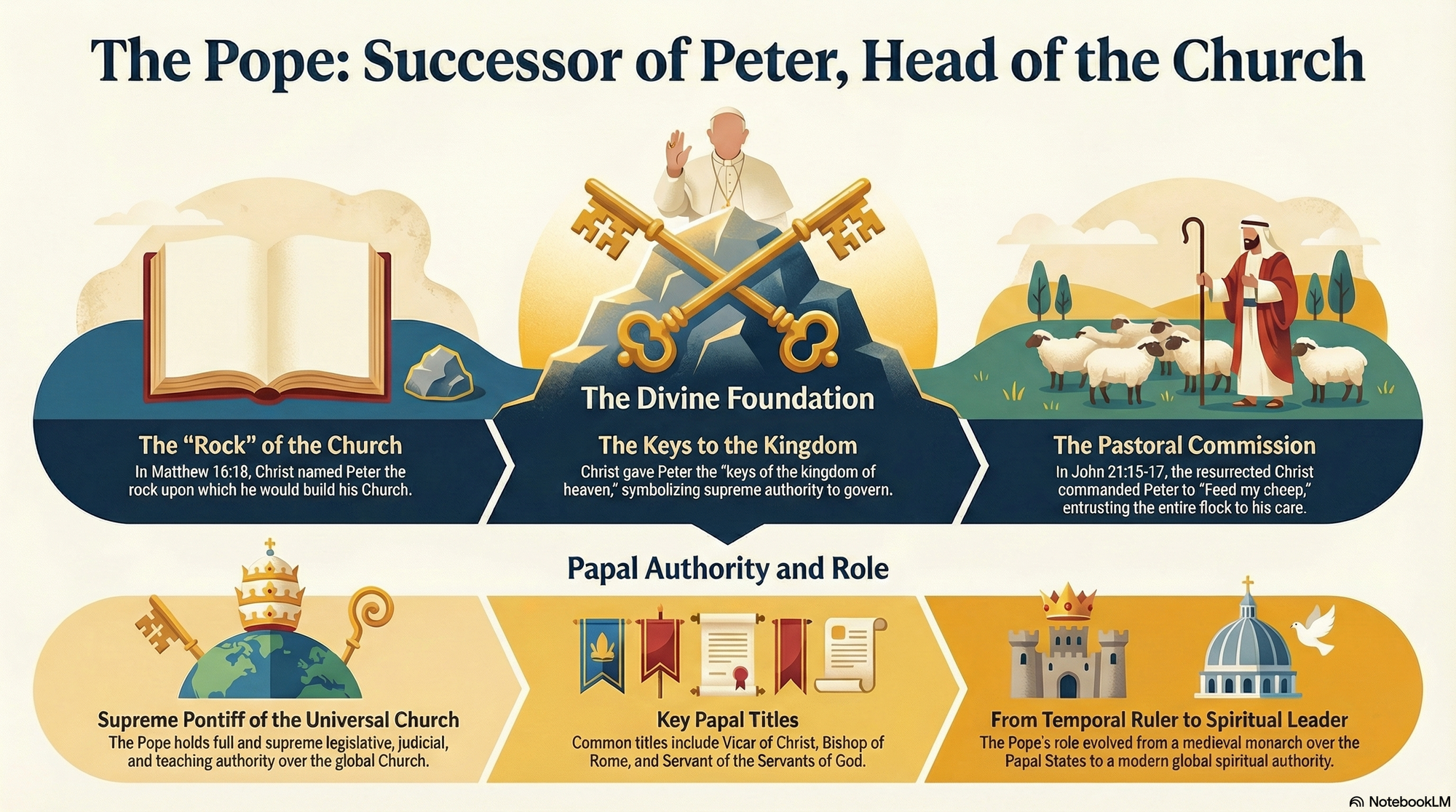
The Pope is the Bishop of Rome and, as the successor of St. Peter, is considered the Vicar of Christ upon earth and the chief pastor of the whole Church. This designation derives from the Ecclesiastical Latin papa, meaning 'father'. Among his numerous dignities, the Pope is also the Supreme Pontiff of the Universal Church (Pontifex Maximus), Sovereign of the Vatican City State, and, as of 2024, the Patriarch of the West. The Holy See (the Pope's jurisdiction) is recognized as a sovereign entity under international law.

The foundational doctrine, defined by the Vatican Council Constitution Pastor Aeternus, holds that the office of Supreme Head was conferred on St. Peter by Christ and is perpetual in the Roman Pontiff. This is supported by the two key Petrine texts. In Matthew 16:17-19, Christ designates Peter as the "rock" upon which the Church is built, making him the principle of unity, stability, and increase. Christ also promised him the "keys of the kingdom of heaven," symbolizing supreme power to govern, which includes plenary legislative and judicial authority, signified by the power to "bind and loose". In John 21:15-17, this promise was fulfilled when Christ charged Peter to "Feed my sheep," placing the entire flock under his charge as shepherd. Peter’s episcopate in Rome, ending in his martyrdom there, ensures that his successors in the Roman See inherit the supreme headship.

The Papal authority is understood to be ordinary, immediate, and episcopal jurisdiction over all the faithful, extending to both pastors and individuals, whether singly or collectively, worldwide. This authority encompasses legislative, judicial, and teaching functions across all matters of faith, morals, discipline, and government. The Pope is the supreme judge of the faithful, and appeals may be made to him in all ecclesiastical causes. The supreme teaching authority includes the solemn right to define doctrine of faith or morals ex cathedra, a prerogative known as papal infallibility, which was proclaimed dogma by the First Vatican Council in 1870. The Pope is elected by the College of Cardinals in a secluded meeting called a conclave.

Links to Sources:

Quiz

Review the questions and verify your answers by clicking the tab.

Which Bible verse names Peter as the rock?

Matthew 16:18

What symbolizes the supreme authority to govern the Church?

The keys of the kingdom of heaven or Papal keys

One Papal title is _____ of the Servants of God.

Servant

True or False: The Pope only has jurisdiction in Rome

False. The Pope holds full and supreme authority over the entire Church.