The Primacy of Peter and the College of Bishops

0:00
/6:48
Chapter Text

The Apostolic Foundation: Understanding the College of Bishops and the Primacy of Peter

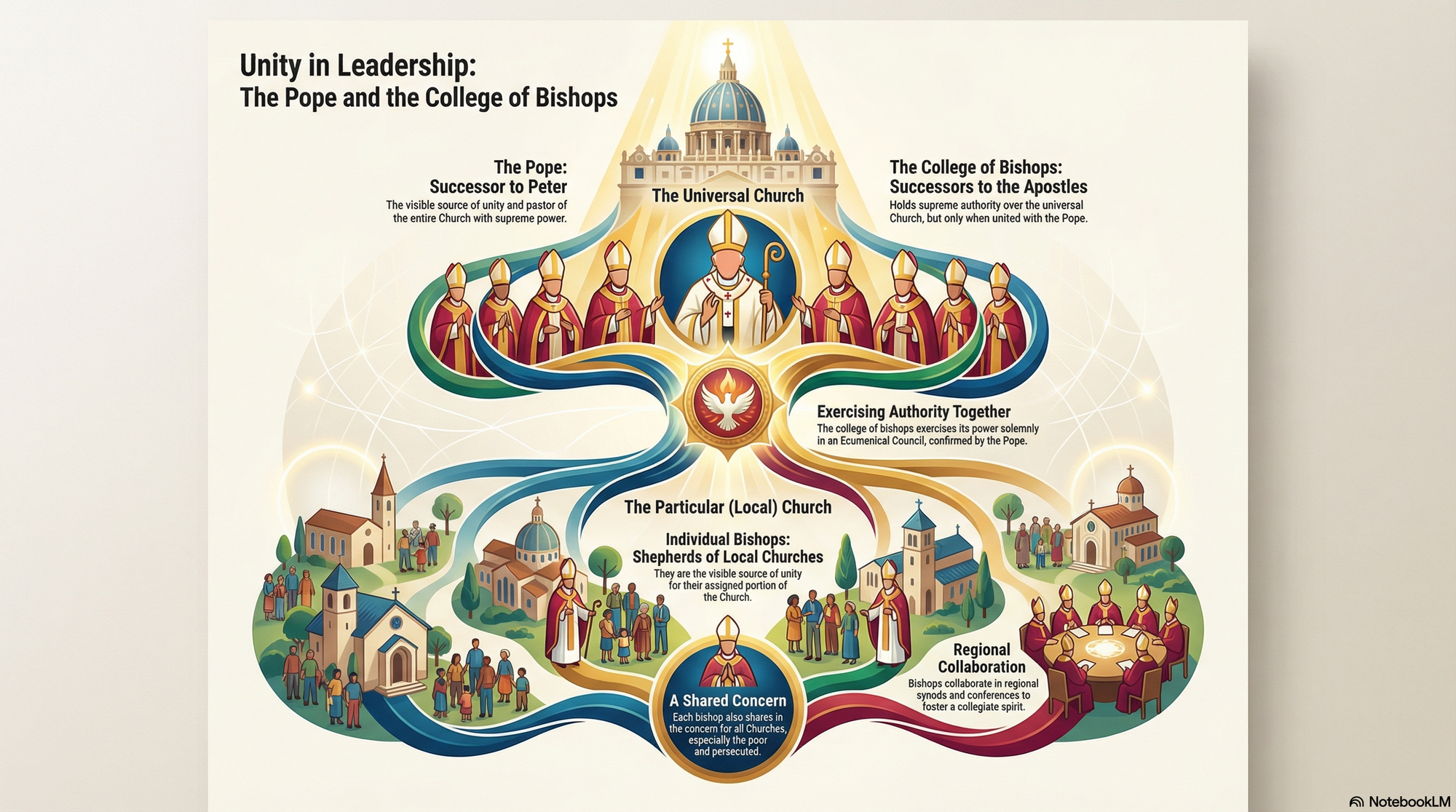
When Christ instituted the Twelve Apostles, he organized them as a permanent college or assembly, placing Peter at their head. This foundational structure dictates the governance of the Church today. Just as St. Peter and the other apostles formed a single apostolic college, the Roman Pontiff (Peter's successor) and the bishops (successors of the apostles) are united and related to one another.

The Lord made Simon alone, whom he named Peter, the "rock" of his Church, giving him the keys and instituting him as shepherd of the whole flock. This primacy continues through the Pope, who, as Peter's successor and Bishop of Rome, serves as the perpetual and visible source and foundation of the unity of both the bishops and the entire body of the faithful. In this role as Vicar of Christ and pastor of the entire Church, the Roman Pontiff has full, supreme, and universal power over the whole Church, which he can always exercise without hindrance.

However, the authority established by Christ is shared in a collegiate manner. The college of bishops, which succeeds the apostles, also possesses "supreme and full authority over the universal Church". This college expresses both the variety and universality of the People of God and the unity of the flock gathered under one head.

Crucially, the college of bishops has no authority unless it is united with the Roman Pontiff. Its power cannot be exercised without his agreement. When the bishops exercise their power over the universal Church in a solemn way, such as in an ecumenical council, that council must still be confirmed or recognized by Peter's successor.

While all bishops share concern for all Churches as members of the college, individually, each bishop serves as the visible source and foundation of unity within their own particular Church, guiding the portion of the People of God assigned to them.

Quiz

Review the questions and verify your answers by clicking the tab.

The Pope is the _______ source of unity for the Church.

Visible

The College of Bishops hold what kind of authority when united with the Pope?

Supreme Authority

When does the College of Bishops exercise its power?

When they hold an Ecumenical Council, confirmed by the Pope.

True or False: A regional collaboration of bishops is called a council.

False. It is called a regional synod or bishops conference